Every private equity firm has a playbook. It knows what it does in the first hundred days, which five numbers it watches in a portfolio company, how it prices an add-on, and when it replaces a chief executive. That playbook is the firm's real intellectual property, and in 2026 it is being tested harder than at any time since the global financial crisis. Almost nowhere has it been written down in a form that anyone other than the partners who built it can run.
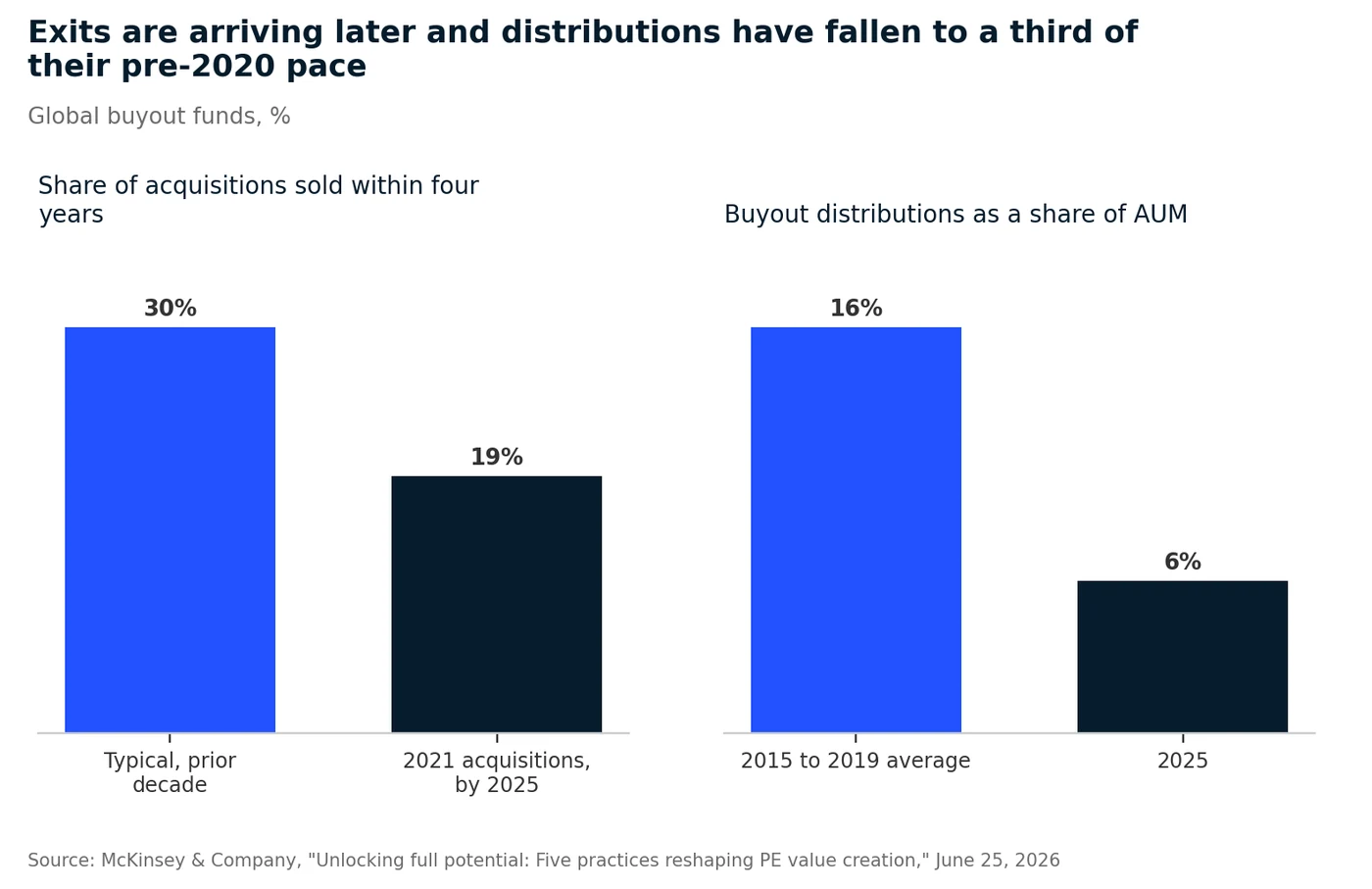
The 2026 numbers describe the pressure precisely. Buyout funds are sitting on roughly 32,000 unsold companies worth about $3.8 trillion, the average holding period at exit has drifted to about seven years from five to six in the 2010s, and distributions as a share of net asset value have been below 15 percent for four years running, a level last seen in 2008 and 2009.1 McKinsey's data make the same point from the fund's side: only 19 percent of companies acquired in 2021 had been sold by 2025, against a typical four-year exit rate of 30 percent in the prior decade, and buyout distributions fell to 6 percent of assets under management in 2025 against an average of 16 percent from 2015 to 2019 (Exhibit 1).2 In the United States, PitchBook counted 13,509 companies in sponsor inventory at the end of June, with continuation-fund exits at 69 for the half year against 158 for all of 2025.3
Exhibit 1
At the same time the source of returns has moved. From 2010 to 2022, nearly 60 percent of buyout value came from leverage and multiple expansion, and purchase multiples reached a record 11.8 times EBITDA in 2025.2 In S&P Global's February survey, 72 percent of general partners ranked operational improvement as the top value-creation lever and 60 percent said higher capital costs were forcing more attention on portfolio company performance.5 Our argument is that the binding constraint on that operational engine is not talent, capital or models. It is that the firm's playbook, the definitions, triggers and decision rights that make its interventions repeatable, lives in partners' heads and deal memos. AI can draft and analyze. It cannot execute a playbook that was never structured. The firms that encode theirs will compound faster across a portfolio than those that rediscover it one company at a time.
Twelve is the new five, and the playbook is the lever
Bain's shorthand for the new deal math is that "12 is the new 5." A typical 2015 buyout borrowed about half the purchase price at 6 to 7 percent, and about 5 percent annual EBITDA growth produced 2.5 times money over five years. With borrowing costs at 8 to 9 percent and leverage of 30 to 40 percent, the same outcome needs 10 to 12 percent growth, and the multiple expansion that powered more than half of buyout returns in the low-rate era is, in Bain's words, "gone for the foreseeable future."4 Exits already show the shift. In Alvarez & Marsal's survey of 200 European fund investors and portfolio company executives, margin improvement accounted for 51 percent of EBITDA growth in companies exited in 2025, against 21.5 percent for exits before 2023.6
The industry has responded by building operating capacity. Since 2021, private equity firms have more than doubled the size of their operating groups.2 In L.E.K.'s April survey of 100 US buyout professionals, 46 percent had expanded their operations teams in the past year, and 68 percent still relied on external advisers for value-creation initiatives.7 Bain's advice for the new era is to build "a system, not a slogan," and to move full-potential diligence into Day 1 execution.4
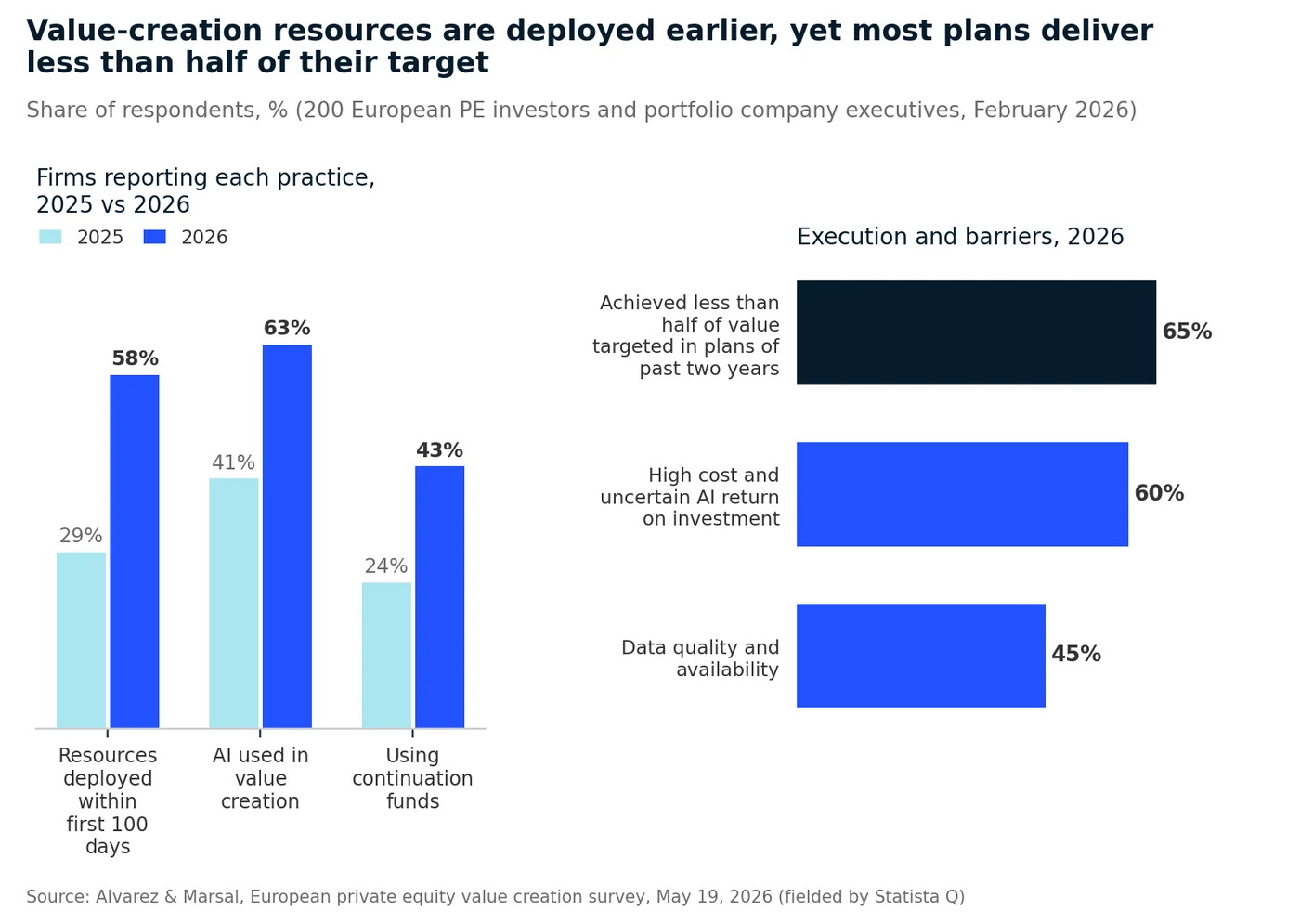
That is where the evidence turns uncomfortable. Capacity is being added faster than the system that would make it repeatable. In the same Alvarez & Marsal survey, 65 percent of respondents said they had achieved less than half of the value targeted in plans from the past two years, even as the share deploying resources within the first 100 days doubled from 29 to 58 percent (Exhibit 2).6 McKinsey found that only about one third of firms re-underwrite a company during the hold with discipline, that 94 percent of sponsors say portfolio company leadership drives value but only 8 percent invest systematically in building it, and that margin improvement in a typical hold is concentrated in the final year, about 6 percentage points, against about 1 point a year earlier on.2 Bain and StepStone's survey of 103 general partners put it plainly: "as always, the challenge is capturing what was underwritten post-close."8
Exhibit 2
The playbook exists. It is not written down.
Ask a senior partner how the firm creates value and the answer is confident and specific. Within the first hundred days we replace the finance function if it cannot close the books on time. We do not approve an add-on above a stated multiple unless the synergy case is procurement, not revenue. We intervene on the chief executive after two consecutive quarters below plan. Every firm has a version of these rules, and the differences between them are the firm's edge.
Ask where those rules are recorded and the answer is a deal memo, an investment committee presentation, a hundred-day plan template and the memory of the partners who have run the play before. The KPI definitions the firm cares about are rarely identical from one portfolio company to the next, and operating partners carry the translation in their heads. McKinsey's observation that operating partners are a limited resource who engage most deeply early in the hold is a polite description of the same thing: the playbook travels with the people, and the people cannot be everywhere.2
FTI Consulting's 2026 Value Creation Index, drawn from 555 senior private equity leaders in 14 countries, shows the consequence lever by lever. Firms report results faster than a year ago, with 63 percent achieving measurable impact within twelve months against 41 percent in 2025, but only 31 percent describe their AI implementation as efficient, and acquisitions, the lever L.E.K.'s respondents name most often as their leading EBITDA driver, are the slowest to pay back, with 25 percent achieving results within twelve months.7, 9 FTI's high performers use the same levers, treating "integration and execution as a core capability."9 A core capability is something the firm can run without the person who invented it in the room.
AI can draft the memo. It cannot run the plan.
Deal teams have adopted generative AI quickly, with measurable effect on the parts of the job that are reading and writing. In L.E.K.'s survey, buyout professionals report an average 28 percent productivity improvement, 57 percent use Claude as their main tool, investment teams use it chiefly for research and diligence synthesis, and only 21 percent rate their own AI expertise as advanced.7 In S&P Global's survey, due diligence is the function where AI is most integrated, at 31 percent, while 64 percent of general partners rate it ineffective for deal sourcing and 75 percent for portfolio monitoring.5 The model is good at the parts that are written down and weak on the parts that depend on how a particular house does things.
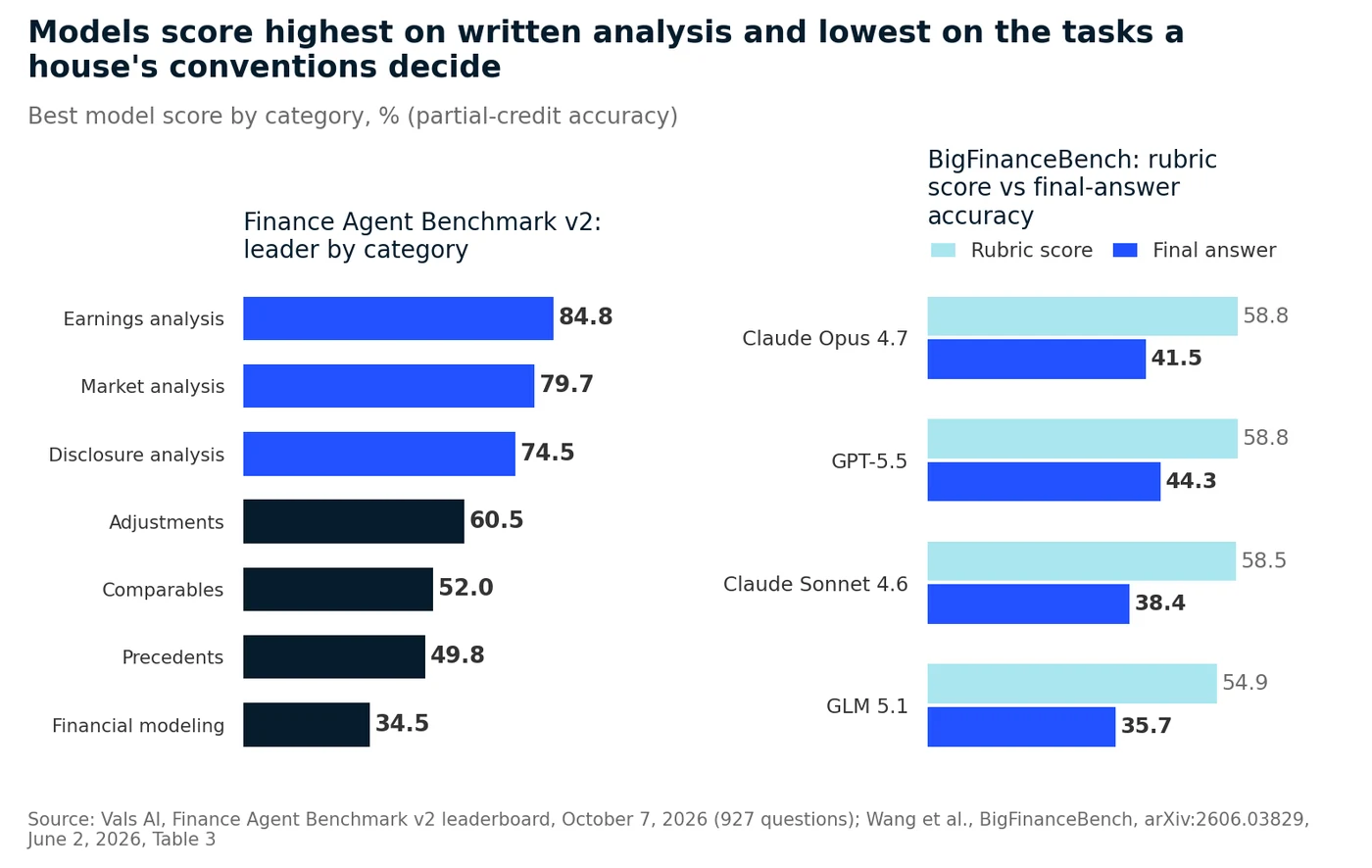
The benchmarks are precise about where the boundary lies. On Vals AI's Finance Agent Benchmark, updated on October 7 with 927 expert-reviewed questions, the leading model, Gemini 4 Argon, scores 84.8 percent on earnings analysis and 79.7 percent on market analysis. The best scores fall to 60.5 percent on adjustments, 52.0 percent on comparables, 49.8 percent on precedents and 34.5 percent on financial modeling, and no model passes every part of a question more than 51 percent of the time. Claude Fable 5.1 and Claude Opus 5.5 sit at 58.9 and 58.6 percent overall, within seven points of the leader (Exhibit 3).10 BigFinanceBench, written by 52 experts who are "predominantly current and former investment bankers and private equity investors," finds the same shape: the best agents score 58.8 percent on expert rubrics and below 45 percent on final answers, and "many failures accumulate before the final arithmetic stage," in source selection, metric definition and accounting adjustment.11 Those are the steps a playbook specifies. Which EBITDA. Which comparables. Which precedent counts.
Exhibit 3
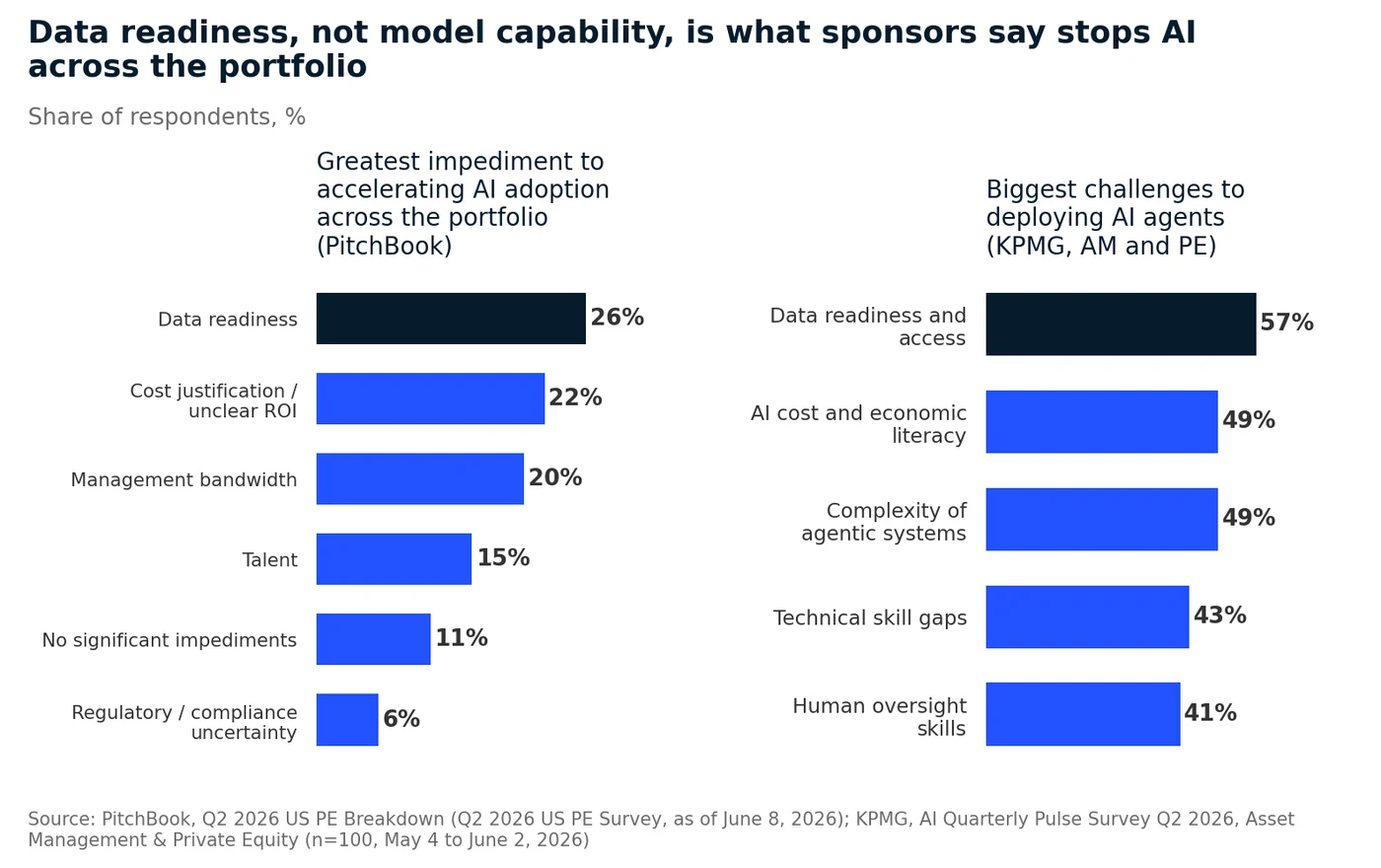
Inside the firms, the limits are organizational rather than technical. Grant Thornton's survey of 100 private equity leaders found that only 5 percent have fully integrated AI into operations, against 14 percent across all industries; 9 percent are very confident they could pass an AI governance audit within 90 days, the lowest of any sector, and 7 percent have a tested AI incident response plan.12 In KPMG's second-quarter pulse of 100 US asset management and private equity leaders, 19 percent are scaling or orchestrating AI agents, data readiness and access is the top barrier at 57 percent, only 4 percent say the operating costs of their AI systems are fully visible, and 21 percent say overrides of AI outputs occur case by case without formal criteria.13 Asked what most impedes AI adoption across their portfolios, PitchBook's second-quarter respondents named data readiness first, at 26 percent, then cost justification, management bandwidth and talent (Exhibit 4).3
Exhibit 4
The problem is not a shortage of models. It is that the thing a model would need in order to act on the firm's behalf, a governed statement of what each metric means, when a threshold has been crossed and who decides what happens next, does not exist. KPMG's respondents say the main thing agents do for them is "aligning shared goals, KPIs and success metrics" across functions, cited by 66 percent.13 That is the playbook, being reconstructed by the tool because it was never written.
Governed definitions change what the model does
The evidence that an explicit, governed layer of business meaning changes model behavior is consistent. In an April 2026 study, three frontier models answered the same 99 analytical questions twice, once with only the database schema and once with a four-kilobyte document of business definitions. Accuracy rose from 50.5 to 67.7 percent for Claude Opus 4.7, from 46.5 to 68.7 for Claude Sonnet 4.6 and from 45.5 to 68.7 for GPT-5.4, and the models were statistically indistinguishable from one another in each condition.14 A second study separated definitions from governance: a model writing SQL directly hallucinated in 79 percent of answers, definitions alone cut that to 40 percent, and only definitions combined with access policy and validation before execution brought the rate to zero.15 Both studies are vendor-adjacent and small, and neither is a buyout fund. But the direction matches the benchmark finding that errors begin in metric definition, and Gartner's March prediction that by 2030 universal semantic layers will be treated as critical infrastructure, with half of organizations using agents to turn governance policies into machine-verifiable data contracts.16
For a private equity firm the implication is concrete. A portfolio of forty companies reports forty versions of adjusted EBITDA, net retention and working capital. The firm's view of which adjustments it accepts is one of its most valuable conventions, and it is applied by hand each quarter. Once that convention exists as governed definitions, a model can apply it to every board pack, flag every departure and show its work. Once intervention triggers exist as explicit thresholds with named decision rights, the same system can tell a deal partner that a company has crossed one before the quarterly review rather than at it. McKinsey reports that re-underwriting a portfolio company, which once took weeks, can now be done in days.2 Speed of that kind depends on the inputs being defined before the model is asked.
Liquidity pressure turns the playbook into a governance object
The exit backlog adds a second reason to make the playbook explicit: when to hold, when to intervene and when to sell is now contested by the firm's own investors. In Coller Capital's summer Barometer of 108 limited partners overseeing $2.045 trillion, 40 percent said general partners are balancing liquidity against portfolio company value "about right," 39 percent said they are not providing liquidity early enough, and 22 percent said the best companies are being sold too early.17 The secondary market has become the pressure valve: Evercore recorded $121 billion of volume in the first half of 2026, up 19 percent, with GP-led transactions at $65 billion and single-asset continuation vehicles at 53 percent of that activity, and 43 percent of the firms Alvarez & Marsal surveyed now use continuation funds, nearly double the 24 percent a year earlier.6, 18 Forty percent of Coller's investors expect continuation vehicle activity to keep rising even when exit conditions improve.17
Each of those decisions rests on a judgment the firm already makes but rarely records: what evidence justifies holding an asset past year five, what a prized asset held back by timing looks like as opposed to one that needs a new plan, and how far below the last mark the firm will sell. Bain reports that in an April poll by ILPA, most limited partners put their tolerance on a full exit at a 5 percent discount to the last mark, and that a majority of buyout assets by count and value were acquired in 2021 or earlier.19 In Alvarez & Marsal's sample, 45 percent of assets in continuation structures were described as performing to plan but needing more time, and 42 percent as prized but held back by timing.6 A firm that cannot state the criteria behind those labels will find them harder to defend.
The software repricing of early 2026 is the sharpest illustration. Public software valuations fell nearly 30 percent in February, private software marks fell about 8 percent through March, and technology deal value fell 70 percent between the fourth quarter of 2025 and the first quarter of 2026.19 KKR's co-chief executive Scott Nuttall told investors in July that software is "all going to be disrupted by AI," and Blackstone's Jon Gray noted that professional, information services and software deals make up 30 to 40 percent of the private equity market.20, 21 The BIS found in July that business development companies have lent around $115 billion to software firms, about a fifth of their lending, without yet pricing that exposure differently.22 In EY's first-quarter pulse, around 60 percent of general partners reported increasing diligence on AI disruption risk.23 A firm whose underwriting playbook states which revenue it considers defensible against AI, and whose portfolio KPIs let a model test that view quarterly, will see the repricing in its own data first.
What the people shaping the next four years expect
The forecasts worth weighting come from people with a fund, a balance sheet or a mandate at stake, and in 2026 they were candid about both the ambition and the time it will take.
- Value creation will be defined by AI readiness, and it will take longer than hoped. Blackstone's president Jon Gray told investors in July that "the value creation story at our companies today is obviously about making them as AI forward as possible," and the firm, with Hellman & Friedman and Anthropic, launched Ode in July to deploy AI across portfolio companies.21, 24 Carlyle's chief executive Harvey Schwartz said in August that the firm is "in the early innings of the impact data science can have across all businesses" and that "it's probably going to take longer than people thought originally."25 Bain's midyear verdict was that "inaction, in fact, has become a strategic choice, not a neutral decision."19
- Investors expect dispersion, not a level playing field. Only 22 percent of the limited partners in Coller's Barometer expect general partners' use of AI to become a source of return outperformance in the next five years, and 70 percent expect it to be used primarily for cost efficiency. Yet 67 percent expect AI adoption to widen the gap between the best-performing funds and the laggards.17 Thirty-nine percent of general partners in the Bain and StepStone survey expect no material financial effect from AI on their portfolio companies in 2026.8
- Bought capability will not stick. Gartner predicted in September that by 2028, 70 percent of enterprises will abandon agentic AI built for them by vendors' forward-deployed engineers because they cannot evolve the systems themselves.16 The playbook a sponsor would want a vendor to encode is the one thing a vendor cannot supply.
- The macro bet is large and the productivity evidence is thin. The BIS General Manager, Pablo Hernández de Cos, said in September that global AI-related investment is expected to rise from around $500 billion to between $3 trillion and $4 trillion by 2030 while the median estimate of its productivity effect is about half a percentage point a year, and warned that disappointing returns could turn "today's capital expenditure boom into a bust."26
Our own expectation, grounded in those views and in the evidence above, is that the period to 2030 will separate sponsors on whether their playbook exists outside their partners. The models will keep converging. Limited partners will keep asking for the criteria behind hold, intervene and sell decisions, and continuation vehicles will keep making those criteria visible. The firms that encode their definitions, triggers and decision rights will run the same play across forty companies at once, re-underwrite annually rather than at exit, and show investors the rule rather than the outcome. By 2028 we expect the leading sponsors' value-creation plans to be governed objects that systems execute against, rather than entry documents, and by 2030 we expect limited partners' due diligence to ask for the playbook in that form, as it now asks for the track record.
Making the playbook executable: four moves
The firms that are ahead are not buying a platform. They are doing four things, in roughly this order, and treating each as a governed asset of the firm rather than a project at one portfolio company.
1. Write the playbook as decisions, triggers and decision rights
Start with the dozen decisions the firm makes most often across the portfolio: the hundred-day priorities, the management change, the add-on approval, the pricing intervention, the re-underwriting, the hold-or-sell call. For each, record the evidence it uses, the threshold that triggers it, who may decide and what the firm will not do. This is small enough to govern and specific enough for a system to check.
- Concrete marker: Each priority decision has a named owner, an explicit trigger and an evidence standard, and a system can tell when the trigger has been met.
- Concrete marker: The hold-or-sell criteria the firm applies to a continuation vehicle are written before the asset is selected, not in the fairness opinion.
2. Standardize the portfolio's meaning, not its systems
Portfolio companies will keep their own ledgers and ERPs. What the sponsor can govern is the definition layer above them: what the firm means by adjusted EBITDA, net retention and cash conversion, which adjustments it accepts, and how each company's reported figure maps to the firm's. The 2026 studies show this is where model accuracy is decided.14, 15
- Concrete marker: Every portfolio KPI in the board pack carries the firm's definition, the company's mapping to it and an owner, so an analyst or a model can trace a number to its source.
- Concrete marker: A new acquisition is mapped to the firm's definitions within the first hundred days, and the mapping is reviewed when the deal team changes.
3. Encode the underwriting and re-underwriting logic
The firm's view of what makes an add-on accretive, how much synergy it will underwrite, and what evidence changes its thesis during the hold is the most valuable and least documented part of its judgment. BigFinanceBench's finding that errors begin in source selection, metric definition and accounting adjustment says where to encode first; McKinsey's finding that only a third of firms re-underwrite with discipline says why.2, 11
- Concrete marker: Add-on and re-underwriting cases are built from the firm's own templates, assumptions and precedent deals, and the system records which were applied.
- Concrete marker: Every portfolio company is re-underwritten against the original thesis at least annually, with departures flagged by the system rather than discovered at exit.
4. Govern the playbook like a fund document
A playbook that a system can execute can also be audited, versioned and improved. Give it the discipline the firm already applies to its valuation policy: an owner, a change log, a review cycle, and a record of every case where a partner overrode it and why. KPMG's finding that a fifth of firms override AI outputs without formal criteria is a reminder that overrides are part of the playbook, and the most informative part.13
- Concrete marker: The playbook has a version number, an owner and a record of changes, and limited partners can be shown the current one.
- Concrete marker: Replacing the underlying model, or the vendor that deploys it, does not require rebuilding the firm's definitions, triggers or decision rights.
The leadership test
No firm has finished this work. A managing partner can test the firm's position by asking six questions:
- If our three most experienced operating partners left this quarter, which parts of our value-creation approach would leave with them?
- Could a system today state, for each portfolio company, the firm's definition of adjusted EBITDA and the adjustments we have accepted?
- Which triggers for a management change or a pricing intervention have we written down, and does anyone outside the deal team know them?
- When we propose a continuation vehicle, can we show investors the criteria we applied, or only the asset we chose?
- What share of the value we underwrote in our last ten deals have we captured, and do we know why the gap exists?
- If we changed our AI vendor next year, what would we have to rebuild?
Firms that can answer these questions have an executable playbook, whether or not they call it that. Those that cannot are relying on the memory of a few people, at a time when the portfolio is larger, the holds are longer and the investors are watching more closely than they have in two decades.
The sponsors that compound fastest over the next four years will not be the ones with the most AI tools or the largest operating group. They will be the ones that wrote down what they actually do, attached authority to it, and made it something their systems and their people can run on every company at once. The models are ready to execute a playbook. The work of structuring one has barely begun.