Ask a consultant why a pension fund hired a particular equity manager and the answer is rarely last year's return. It is the process: how the team sizes a position, what it needs to see before it believes a thesis, how the risk budget is set and who can spend it, and what happens when the portfolio manager and the risk officer disagree. That process is what the client bought. It is also, in most firms, nowhere written down in a form that a new analyst, an auditor or a system could apply. In 2026, as every asset manager puts language models into research and operations, that omission has become the industry's central constraint.
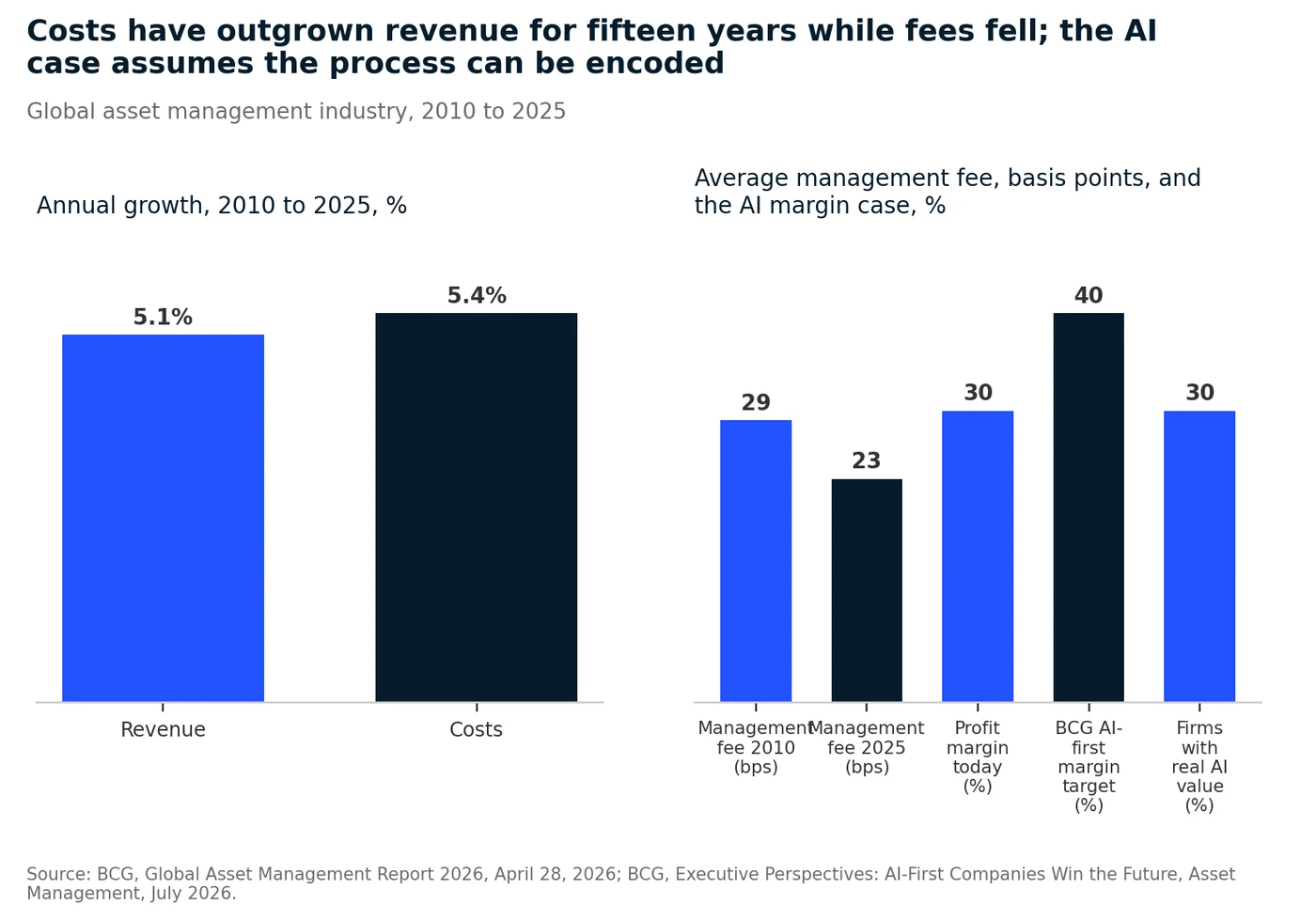
The economics make the point. Global assets under management reached $147 trillion in 2025, nearly triple the level of 2010, yet more than 80 percent of the industry's gross revenue growth came from market appreciation, and aggregate profit margins sit at about 30 percent, roughly where they stood in 2010. Over fifteen years revenue has grown 5.1 percent a year and costs 5.4 percent, so that scale has stopped paying for itself; average management fees fell from 29 basis points to 23 over the same period, and institutional fees are falling about 3 percent a year.1 AI was supposed to break the link between assets and cost. So far it has not. In BCG's July assessment, about 30 percent of asset managers have generated real value from AI, and the leaders among them deploy twenty times more agentic solutions than the laggards.2
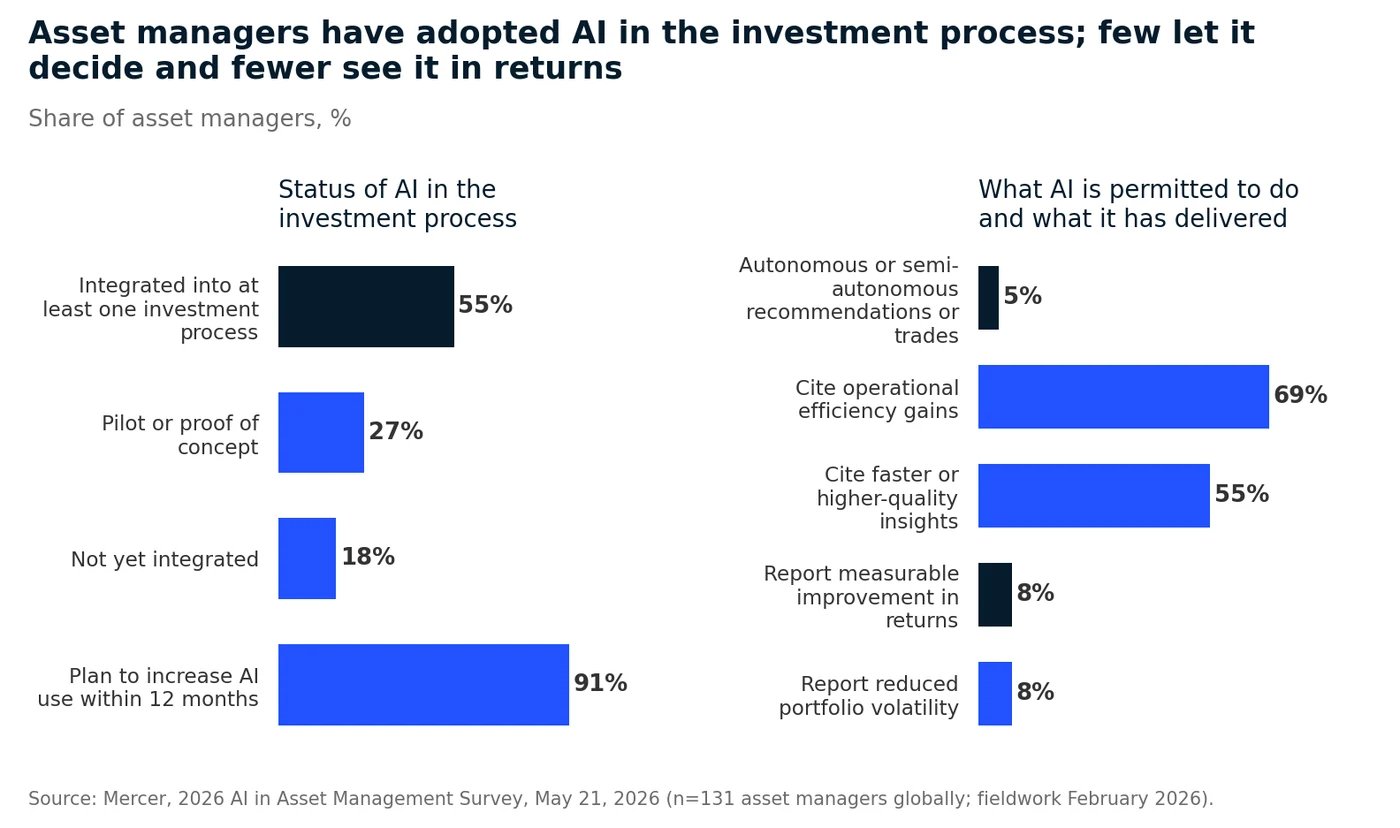
Adoption itself is no longer the question. In Northern Trust's biennial survey of 300 asset management leaders, published in September, every respondent reported deploying AI in some form, with research among the leading use cases.3 Mercer's February survey of 131 managers found 55 percent had integrated AI into at least one investment process and 91 percent planned to increase use within a year; but only 5 percent let AI make or semi-autonomously make a recommendation or trade, and only 8 percent reported a measurable improvement in returns (Exhibit 1).4 In the European securities sector, where ESMA surveyed 728 entities including 277 investment managers, 53 percent of investment firms and managers reported no AI use case at all, 87 percent of all use cases were internal-only and 77 percent had low or no autonomy.5 The tools are in the building. The process they are meant to serve is still in people's heads.
Exhibit 1
What clients buy is a process they cannot see
An investment process is a set of constraints and conventions that most firms describe in a pitch book in two pages and apply in practice through a thousand unwritten rules. The mandate says the fund may hold up to 5 percent in any single name; the house convention says that above 3 percent the position needs a second analyst's work. The risk budget is expressed in tracking error; the real rule is which drawdown makes the chief investment officer call a meeting. The research template asks for a target price; what actually gets a stock into the portfolio is a particular kind of evidence, assembled in a particular order, that the senior people have learned to trust. Who may override the model, the screen or the junior analyst, and on what grounds, is known to everyone on the floor and documented nowhere.
That is the asset. It is why Northern Trust's respondents, cutting product ranges and outsourcing non-core work, are "directing resources toward investment expertise," with the share prioritizing product expansion down from 60 percent in 2024 to 47 percent and the share planning to shrink the product set up from 5 to 28 percent.3 It is why 85 percent of US institutional asset owners use investment consultants for manager selection and monitoring, why the top fifteen of those consultants now advise on 90 percent of US institutional tax-exempt assets, and why the first thing asset owners rate a consultant on is investment philosophy and beliefs rather than a number.6 And it is what AI deployments in research and operations are trying to reproduce without anyone having specified it.
The consequence shows up most clearly when the process is absent. In the Nof1 trading experiment reported by Bloomberg in May, eight frontier models were each given $10,000 and the same instructions to trade US technology stocks for two weeks at a time; across 32 result sets a model finished in profit six times, and under the same prompt one model placed 158 trades while another placed 1,418.7 Nobody who runs money would read that as a finding about the models. It is a finding about the instructions. A prompt is not a process, and a model given a portfolio without the firm's constraints, risk budget and evidence standard will invent its own.
The models have the mechanics, not the house view
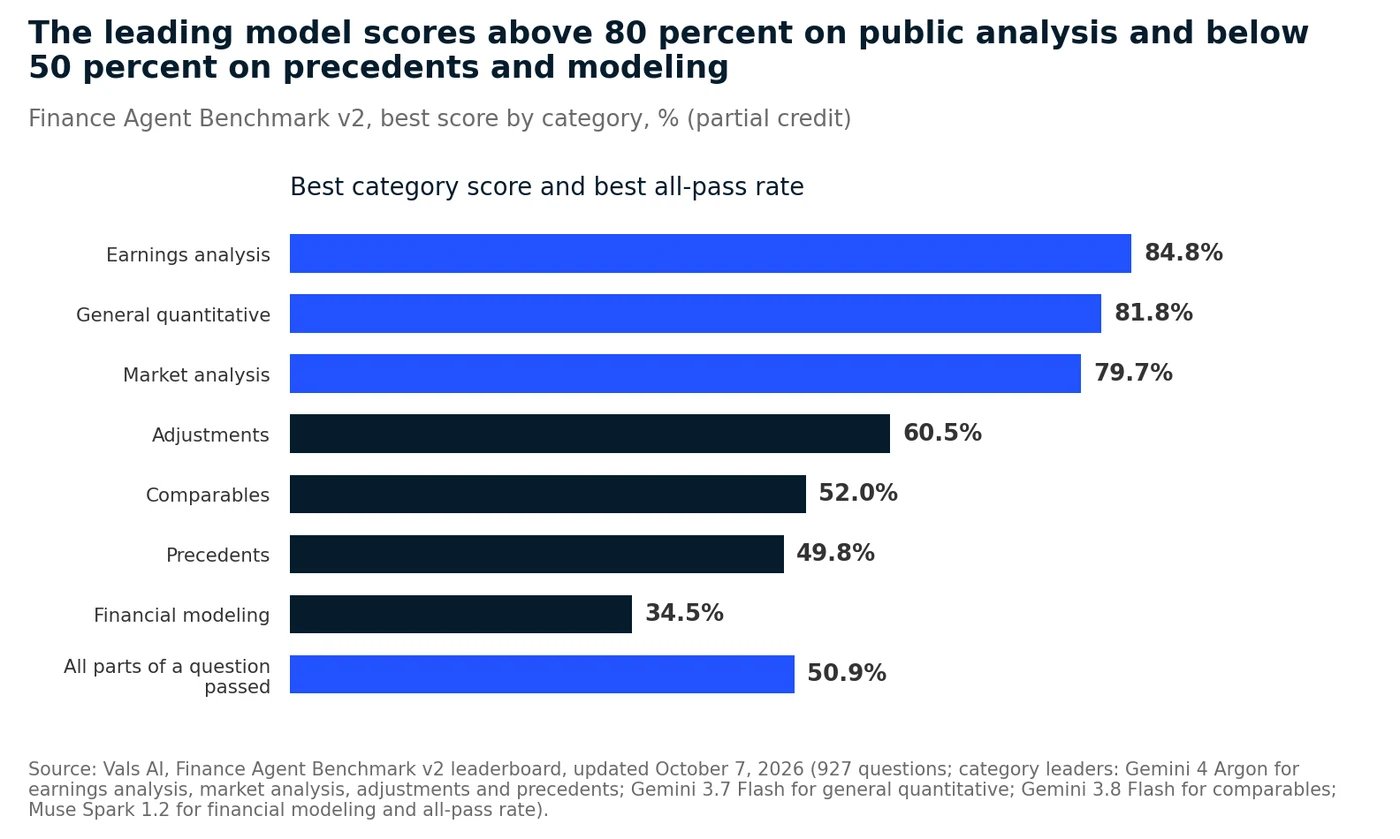
The benchmarks of 2026 draw the line with some precision. On the Finance Agent Benchmark v2, which gives agents search and filing tools and 927 questions reviewed by finance professionals, the leading model as of October 7, Gemini 4 Argon, scores 84.8 percent on earnings analysis and 79.7 percent on market analysis, and the best general quantitative score is 81.8 percent. The scores fall on the work that depends on how a particular house does things: adjustments, 60.5 percent; comparables, 52.0 percent; precedents, 49.8 percent; building the financial model an analyst would build, 34.5 percent. No model passes every part of a question more than 51 percent of the time (Exhibit 2).8
Exhibit 2
BigFinanceBench, built by a team from Rogo and OpenAI with 52 former investment-banking and private-equity professionals writing the questions, found the same thing from the other direction. The best agents scored below 60 percent on expert rubrics and below 45 percent on final answers, the three leaders sat within 0.3 points of each other, and the errors, the authors wrote, "mostly come before arithmetic": in source selection, metric definition and accounting adjustment.9 In an asset manager those are precisely the choices that the investment process makes. Which adjusted earnings figure the firm uses, which peer set it treats as comparable, which precedent it considers relevant and which it discards, are house conventions. The model does the arithmetic well. It does not know the house.
None of this means the capability is small. Ken Griffin, who in January dismissed AI output as "garbage" beneath an impressive surface, told a Stanford audience in May that work Citadel "would usually do with people with master's and PhDs in finance over the course of weeks or months" is "being done by AI agents over the course of hours or days."10 BCG's estimate is that an analyst who today monitors 20 to 40 names could, with agents, expand research coverage two to five times.2 But coverage is only valuable if what gets covered is judged by the firm's standard, and a two-to-five-fold increase in research produced to no explicit standard is a two-to-five-fold increase in work for the senior people who have to apply it by hand.
Why the margin has not moved
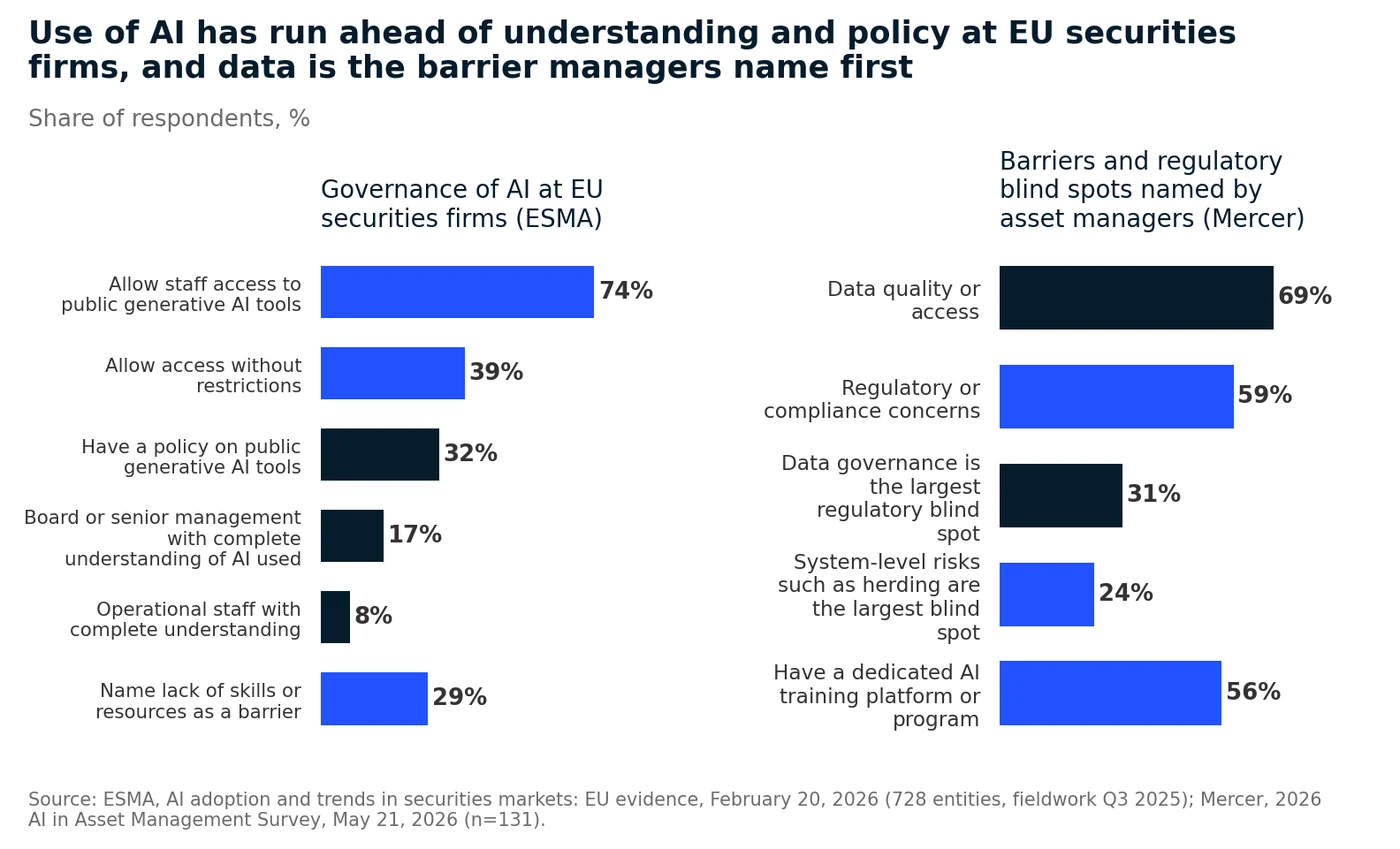
The gap between adoption and value in asset management has a specific shape, and it is not the one the vendors describe. Mercer's respondents named data quality or access as the leading barrier, at 69 percent, with regulatory or compliance concerns at 59 percent; asked where existing regulatory frameworks have blind spots, 31 percent pointed to data governance and 24 percent to system-level risks such as herding.4 Nearly half of Northern Trust's respondents named consolidating data from multiple sources as their biggest data challenge, and sourcing and aggregating investment analytics was the leading challenge for front-office teams.3 In SimCorp's January survey of 200 buy-side executives at firms with at least $10 billion in assets, 70 percent were using AI in the front office, up from roughly 10 percent actively exploring it a year earlier, and the top technology initiatives were vendor consolidation, at 58 percent, and modernizing data infrastructure, at 54 percent.11
Every one of those answers is a data answer to a knowledge problem. The data an investment team needs is mostly available. What is missing is the layer that tells a system what the firm means by a position limit, which research counts as complete, and whose approval a departure from the model requires. Without it, the firm cannot make a model's output safe to act on, so it does not; Mercer's 5 percent autonomy figure and ESMA's 77 percent low-or-no autonomy figure are the same observation.4 5 The work moves from the analyst to the reviewer, the reviewer applies the unwritten process by hand, and the cost base does not fall. BCG's own target for an AI-first manager, a 25 to 35 percent cost reduction over three to five years and a move in margins from about 30 percent to 40 percent or more, assumes that the process has been encoded well enough for agents to run inside it (Exhibit 3).1 2
Exhibit 3
Firm size is doing most of the sorting for now. In Acuity's survey of 80 senior asset management executives, 5 percent described AI as fully integrated, 37 percent reported moderate adoption, 39 percent were at an exploratory or initial stage and 19 percent were not using it; the fully integrated group was drawn mainly from firms managing more than $100 billion.12 The larger firms are not winning because their models are better. They have the scale to pay people to write the process down, and their technology spending, which BCG puts at roughly 5 percent of costs at $50 billion of assets and 15 percent above $1 trillion, is already a fixed cost of running the process rather than a project.1
Regulators are asking for the process, not the model
Supervisors of asset managers spent 2026 declining to regulate the technology and asking instead for exactly the layer most firms lack. The SEC's Division of Examinations said in its fiscal 2026 priorities that it would "review for accuracy registrant representations" about AI capabilities, whether firms have "implemented adequate policies and procedures to monitor and/or supervise their use of AI technologies," whether "operations and controls in place are consistent with disclosures made to investors," and whether algorithms "lead to advice or recommendations consistent with investors' investment profiles or stated strategies."13 In January the director of the Division of Investment Management, Brian Daly, described an agent that could "review dozens or hundreds of proxy statements," then set the condition: "AI agents need to be trained and their output needs to be reviewed," within "principles of transparency, auditability, and consistency with fiduciary duties."14 In September the chairman, Paul Atkins, said the SEC "will not prescribe the specific models that firms must employ," and in the same remarks that "opaqueness in models obscures accountability."15
The United Kingdom and the European Union are on the same line. The FCA's 2026 wealth management survey, covering about 400 firms, found only 13 percent using in-house or third-party AI tools and 45 percent using or considering them, and noted that adoption "may now be higher"; its second AI Live Testing cohort, eight firms including UBS, Barclays and Lloyds, began testing in April with an evaluation due in the first quarter of 2027.16 17 ESMA's survey found that only 17 percent of firms' boards and senior management had a complete understanding of the AI they used, and 8 percent of operational staff; 74 percent of firms allowed staff to use public generative AI tools, 39 percent without restriction, and only 32 percent had a policy on it (Exhibit 4).5 IOSCO's final supervisory toolkit, published in May, organizes what securities regulators will ask about under four headings: governance and risk management, third-party and outsourcing risk, disclosure, and recordkeeping and reporting.18
Exhibit 4
Read together, those expectations describe a firm that can show, from its records, which mandate constraint a system applied, which evidence standard a research output met, and who was permitted to act on it. A manager whose process lives in the heads of its portfolio managers can answer those questions only by interview. One that has encoded the process as governed knowledge answers them from the system, and the same encoding is what makes the system safe enough to be given more than 5 percent of the decisions.
The process is walking out of the building
The storage medium for the investment process has always been people, and that storage is depreciating. In April, Franklin Templeton announced that 25 portfolio managers across seven subsidiaries would retire after accepting voluntary buyouts offered in February on age and tenure criteria, affecting dozens of strategies including the flagship Western Asset core bond funds; Morningstar called the departures "significant losses of talent and knowledge" and noted that the manager of Franklin Utilities had joined in 1992 and run the fund since 1999.19 Across the US securities, commodities, funds and trusts industry, 353,000 of 1,490,000 employed people in 2025 were aged 55 or over, 23.7 percent of the workforce.20 In the ESMA survey, 29 percent of firms named lack of skills or resources as a barrier to AI and 6 percent said they had little or no internal expertise and relied on third parties.5
A retiring portfolio manager does not take the data. What leaves is the process: the sizing rule that was never a rule, the evidence that would have changed the call, the two sectors where the manager never trusted the screen. Consultants price this as key-person risk, and most firms answer with an org chart. The answer that actually transfers the asset is to capture how the senior people decided, from the research notes, committee minutes, position changes and overrides they have already produced, confirm it with them, and govern it. The same object that satisfies a consultant's due diligence satisfies a supervisor's examination and makes an agent's research usable.
What the people shaping the next four years expect
The forward views that deserve weight are those from people with assets, a balance sheet or a supervisory mandate at stake. In 2026 they were specific.
- The economics will be set by the firms that encode their process. Larry Fink's March letter set BlackRock's targets for 2030 at revenue above $35 billion, organic base fee growth of 5 percent or more and adjusted operating margins of 45 percent or more through the cycle, and said "the combination of systematic insight and human oversight will help define the next era of investing."21 BCG expects agentic AI's share of AI value to double from 16 to 33 percent by 2028, with about 90 percent of asset managers considering agentic deployment within six to twelve months, and leaders already earning 3.8 times the shareholder return of laggards.2
- Bought capability will not stick. Gartner predicted in September that by 2028, 70 percent of enterprises will abandon agentic AI built for them by vendors' forward-deployed engineers because they "fail to build internal capability," and in April that in the agentic era "control of enterprise context is economic power."22 SimCorp's respondents already rank vendor stability, at 57 percent, above feature sets when choosing AI tools.11
- Governance will decide who is allowed to use the capability. In T. Rowe Price's 2026 study of 36 defined contribution consultant and advisor firms overseeing $10.3 trillion, the share saying it was "too early to know" about AI fell from 44 percent to 14 percent in a year, and firms with formal AI policies used AI about 50 percent more often across business functions than those without.23 The SEC, FCA, ESMA and IOSCO positions above all point the same way: the firm that can explain its process will be permitted to automate it.
- The macro returns are uncertain and the spending is not. The BIS General Manager, Pablo Hernández de Cos, told the Global Fintech Fest in September that global AI-related investment is expected to rise from around $500 billion to between $3 trillion and $4 trillion by 2030, while the median estimate of its productivity effect is about half a percentage point a year; "should the returns to AI disappoint," he said, "a pullback in investment could turn today's capital expenditure boom into a bust."24
Our own expectation, grounded in those views and in the benchmarks above, is that by 2030 the investment process will be treated as a governed asset in the same way the risk model is today, with an owner, a version history, an evidence standard and an audit trail, and that the firms which get there first will show it in two numbers: research coverage per analyst and the share of decisions a system is permitted to take without a senior reviewer. The models will keep converging; BigFinanceBench's three leaders already sit within a third of a point of each other. Fees will keep falling at 1 to 3 percent a year. Supervisors will keep asking which constraint, which evidence and whose authority applied. By 2028 we expect consultants' due diligence questionnaires to ask for the encoded process directly, and we expect the first examination findings against asset managers to turn not on a model's error but on a firm's inability to state the process the model was supposed to follow.
Encoding the investment process: four moves
The firms that are closing the gap are not buying a research platform and hoping. They are doing four things, in roughly this order, and treating the result as intellectual property rather than documentation.
1. Write the mandate as rules, not prose
Begin with the constraints that already exist in legal form and the conventions that sit behind them: position and sector limits, liquidity floors, the risk budget and how it is allocated across sleeves, the drawdown and tracking-error thresholds that trigger review. For each, record the rule a system can check, the house convention that tightens it, and the owner. This is the inventory the SEC's examiners are looking for when they test whether "operations and controls in place are consistent with disclosures made to investors."13
- Concrete marker: Every mandate constraint exists as a machine-checkable rule with a named owner, a scope, an effective date and the house convention that applies above the formal limit.
- Concrete marker: A system can state, for any position, which constraints apply and how much of each budget it consumes.
2. Define what counts as evidence for a thesis
Every investment team has an evidence standard. Few have written it. Specify, per strategy, what a research output must contain before it can support a position change: which adjusted figures the house uses, which peer set is comparable, which sources are acceptable, which precedents are relevant, and what a dissenting view must address. BigFinanceBench's finding that errors begin in source selection, metric definition and adjustment says where the standard matters most.9 With the standard explicit, a two-to-five-fold expansion in agent-produced coverage is reviewable; without it, every output is reviewed from scratch.
- Concrete marker: Each strategy has a written evidence standard, and every research output, human or agent, records which parts of it were met and which were not.
- Concrete marker: House definitions for adjusted metrics, comparables and precedents are versioned and owned, not inferred by each analyst or each model call.
3. Attach override rights and record every use of them
The most valuable part of an investment process is the exception: when the portfolio manager overrode the screen, when the risk officer vetoed the trade, when the committee decided against the model. Record who may override what, on what grounds, who must be told, and keep each override as a fact pattern with its reason. That record is Daly's "transparency, auditability, and consistency" made concrete, and it is the only way to show a supervisor or a consultant that human oversight is a design rather than an assertion.14
- Concrete marker: Decision rights are explicit for each class of decision, and the cases a human must see before a system acts are specified in advance.
- Concrete marker: Every override is logged with the rule it departed from and the reason, and the log is reviewed for conventions that should become rules.
4. Govern the process like a model, and use it for succession
Asset managers already run model risk management: an inventory, owners, validation, change control and monitoring. Apply the same discipline to the encoded process, and make validating it a formal part of every senior departure. Franklin's 25 retiring portfolio managers represent the largest involuntary knowledge transfer the industry has seen this year; the firms that extract conventions from the records those managers leave, and have them confirmed before the last day, keep the asset their clients paid for.19
- Concrete marker: The encoded process has an inventory, owners, review cycles and a change log, and replacing the underlying language model requires none of it to be rebuilt.
- Concrete marker: Succession planning for a portfolio manager includes a validated capture of that manager's conventions and overrides, not only a named successor.
The leadership test
No firm has finished this work. Leaders can test their own position by asking six questions:
- If our three most senior portfolio managers retired this quarter, what part of the investment process we sell to clients would leave with them?
- Can a system today state, for any position, which mandate constraints, risk budgets and house conventions apply?
- Do we have a written evidence standard for a thesis, and could we tell a consultant which agent-produced research met it?
- Who may override the model, the screen or the analyst, is it written down, and is every override recorded with its reason?
- If the SEC, the FCA or ESMA asked which process an AI output followed, would we answer from the system or from an interview?
- If we replaced our language model next year, what would we have to rebuild?
Firms that can answer these questions have encoded their process, whatever they call it. Firms that cannot are paying twice: once for the AI that produces research to no stated standard, and again for the senior people who apply the standard by hand, until they leave.
The asset managers that capture value from AI will not be those with the most agents or the largest research budget. They will be the ones that treated their investment process as what it is, the firm's intellectual property, wrote it down as governed knowledge, attached authority to it and kept it current. Clients have been buying that process for decades. The technology to run it at scale has arrived. The work of making it explicit has not been done.