Every community bank and credit union has a person who knows. The chief credit officer who can say, without opening the file, which of the county's excavation contractors pays late and which one pays late but always pays. That knowledge is the institution's underwriting. In most institutions it is held by two or three people who are closer to retirement than anyone else in the building.
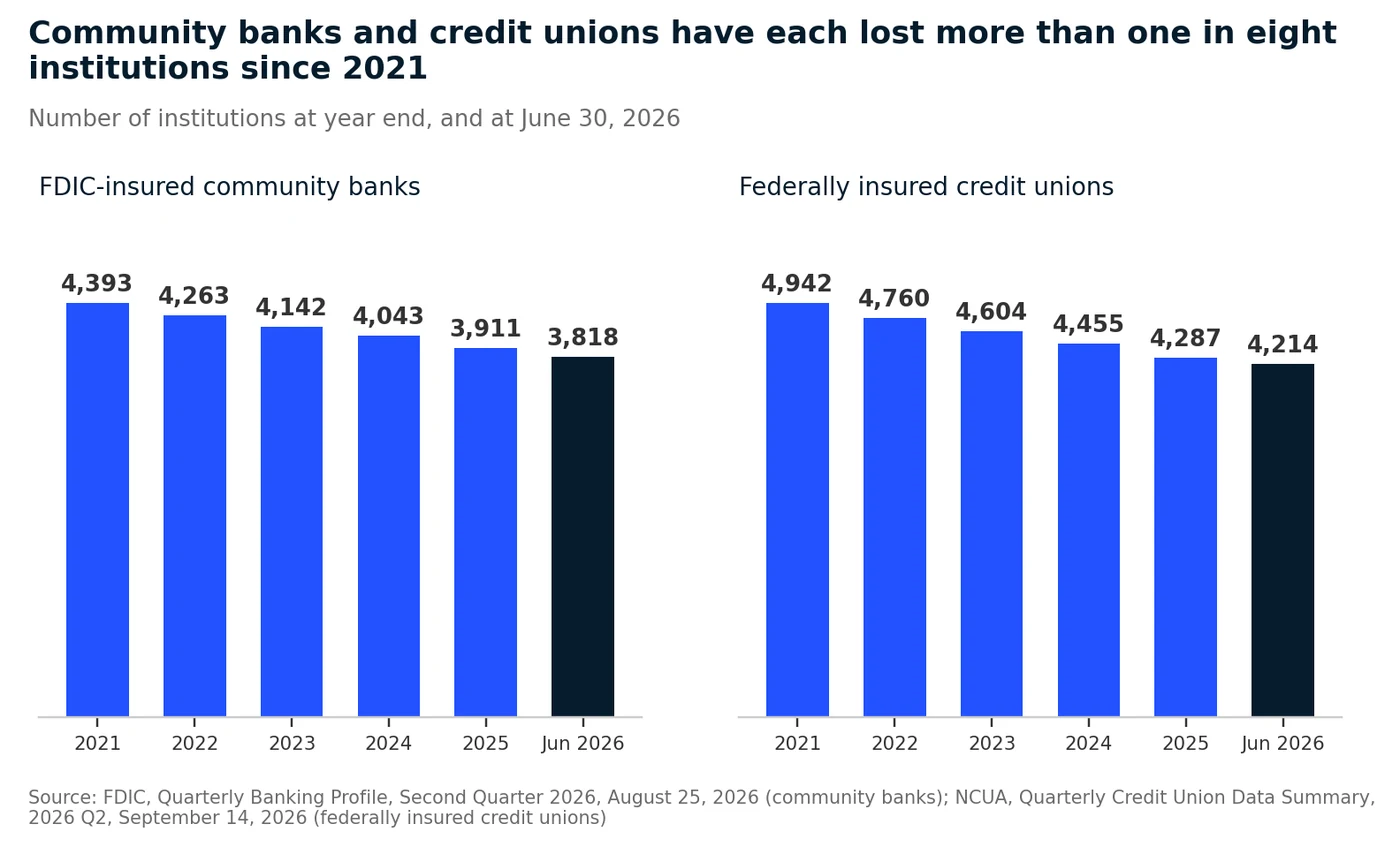
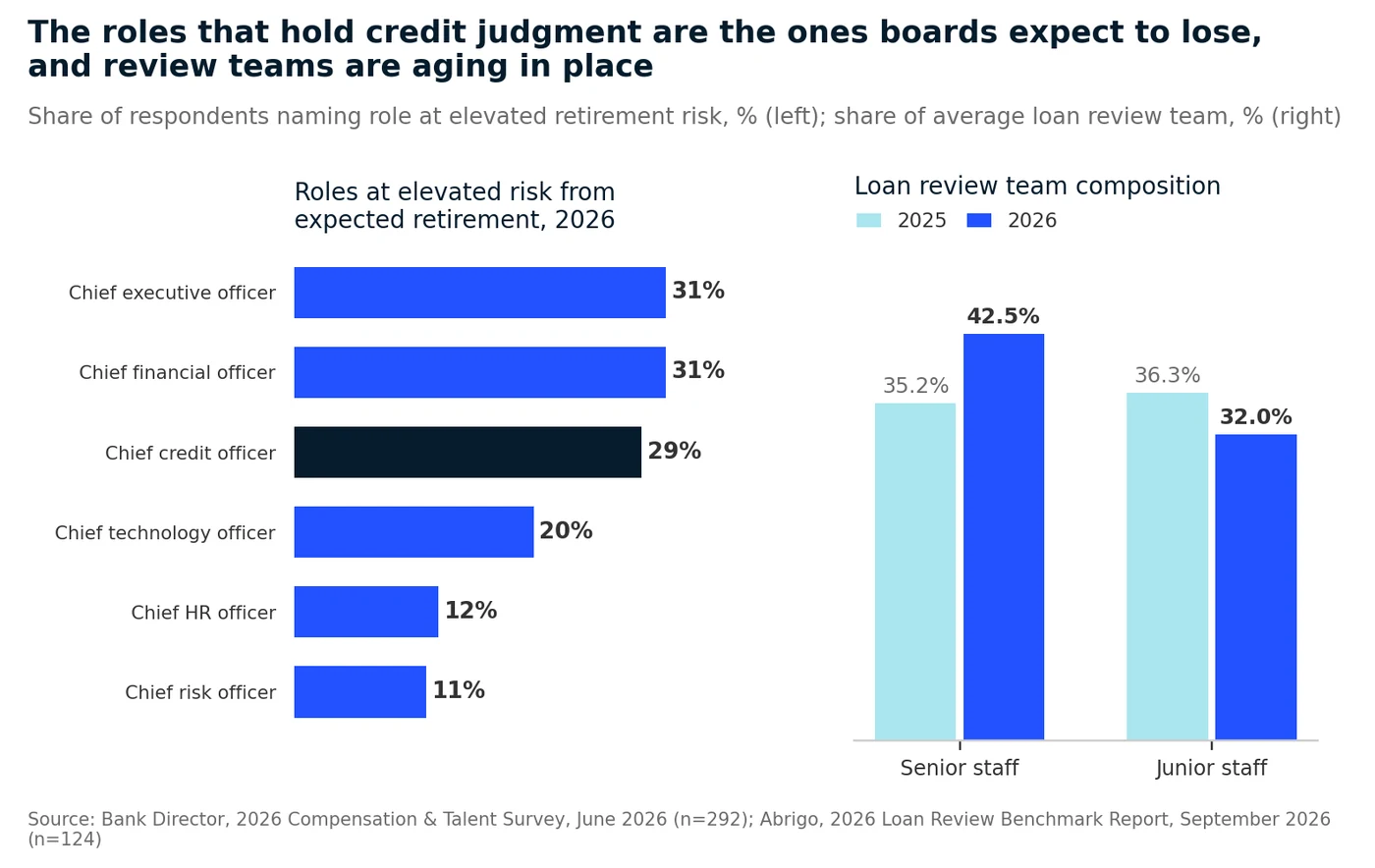
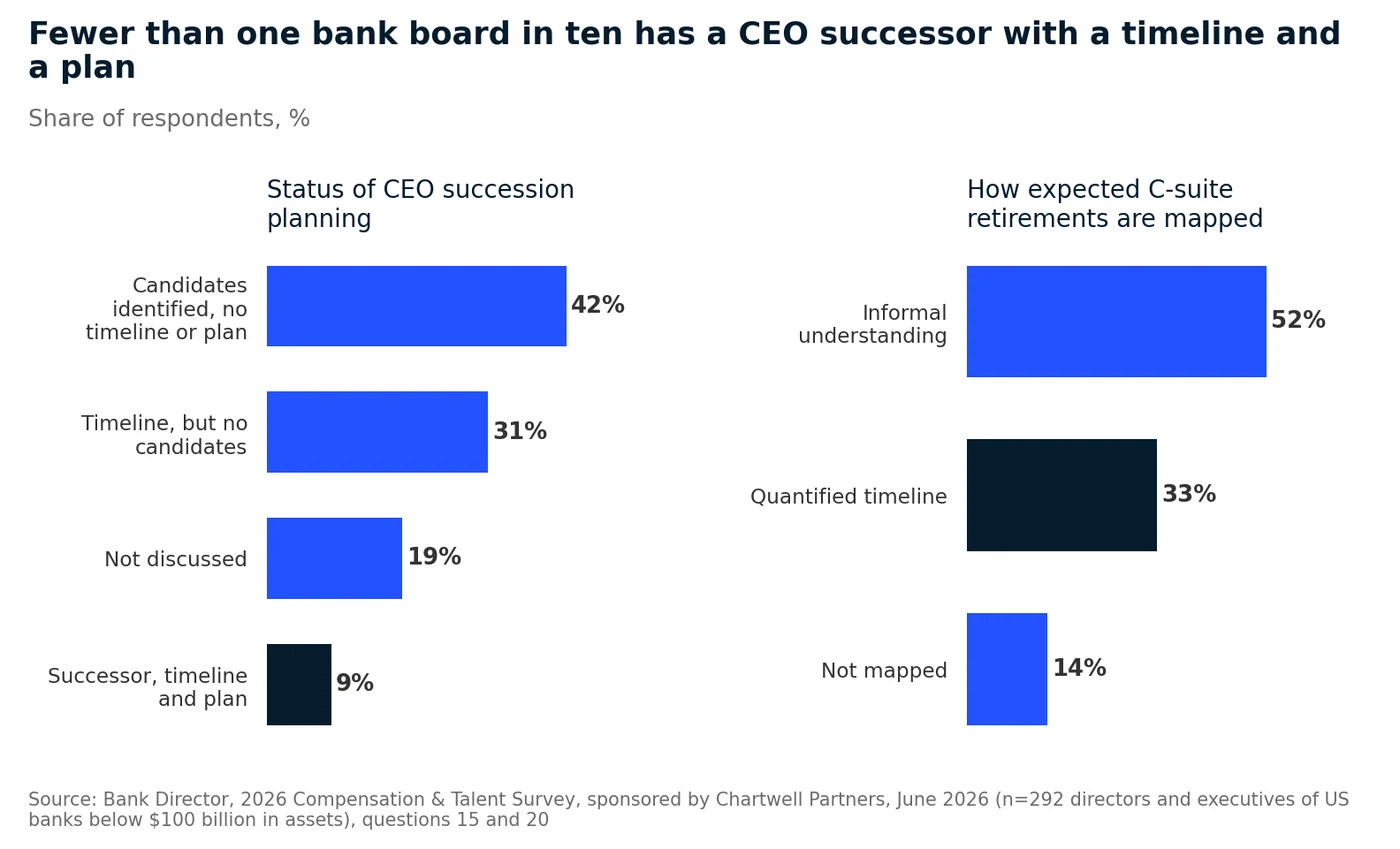
The 2026 numbers describe how fast the building is changing around them. At June 30, 2026, there were 4,238 FDIC-insured institutions, 183 fewer than a year earlier; 90 were absorbed by mergers in the first half of the year alone. The 3,818 community banks among them are 575 fewer than at the end of 2021, a decline of 13.1 percent in four and a half years.1 Federally insured credit unions fell to 4,214 from 4,370 a year earlier and 4,942 at the end of 2021, a 14.7 percent decline that the NCUA describes as "consistent with long-running industry consolidation trends" (Exhibit 1).2 Consolidation is not the only exit. In Bank Director's 2026 survey of 292 bank directors and executives, the CEO and the chief financial officer, at 31 percent each, and the chief credit officer, at 29 percent, were the roles most often named as at elevated risk from an expected retirement, and only 9 percent of boards had a named CEO successor with a timeline and a plan, down from 17 percent a year earlier.3
Exhibit 1
The technology that is supposed to relieve this pressure has arrived in a form that does not. In the Conference of State Bank Supervisors' 2026 survey of 330 community banks, 53.0 percent are piloting AI or using it in limited functions and 8.8 percent have deployed it across multiple functions; 50.4 percent name credit underwriting or risk modeling as an area of current or planned use.4 The tools can read the file. They cannot apply the lender's knowledge of the county, because that knowledge has never been written down in a form a system can use. Our argument is that for small institutions the institutional intelligence gap is, above all, a succession problem: credit and customer judgment is concentrated in a few long-tenured people, those people are leaving, and supervisors have begun to treat what happens to that judgment as their business.
Consolidation is a knowledge event
In small institutions a merger is usually also the moment the knowledge leaves. The acquirer takes the loan book, the core contract and the deposits; the local judgment that priced the book walks out through retirement, redundancy or an earn-out that nobody renews. The NCUA analysis that underpins its succession planning rule found that poor succession planning was a primary or secondary reason in 32 percent of credit union consolidations between 2003 and 2012, and NCUA data cited in the rulemaking showed that 11 of 149 mergers in the second half of 2023 and first half of 2024 cited an inability to obtain officials.5 In the CSBS survey, among bankers who had seriously considered an acquisition offer, the share rating succession planning an extremely or very important reason rose from 28 percent in 2025 to 42 percent in 2026, and 55.1 percent of all respondents rated leadership succession an extremely or very important internal risk.4
The deals have also changed shape. NCUA-approved credit union mergers fell from 263 in 2014 to 157 in 2025, but the average assets of a merged credit union rose from $23.2 million to $285.3 million, and credit unions with $100 million to $250 million in assets went from 5 percent of mergers in 2023 to 22 percent in the first quarter of 2026. In that quarter, 82 percent of mergers cited "expanded services" and only 7 percent poor financial condition.6 These are healthy institutions choosing to merge. Their knowledge is not being rescued from failure; it is being valued, implicitly, at whatever the acquirer thinks a retiring lender's memory is worth once the lender has gone.
The agencies' response in 2026 has been to make mergers easier, not harder. The Comptroller of the Currency told Arizona bankers in August that "more than half of the community banks in the United States have disappeared" since the Dodd-Frank Act, and that "a Main Street comeback requires a community bank comeback."7 Vice Chair for Supervision Michelle Bowman told the Community Banking Research Conference on October 6 that mergers "may actually create a stronger and more competitive banking environment."8 A board that expects to be on either side of such a transaction has a direct financial interest in documenting what its senior people know before the price is set.
The judgment sits in a few people, and they are nearest the exit
Across all US occupations, 23.2 percent of employed people were aged 55 or over in 2025. Among credit counselors and loan officers the figure was 28.7 percent, and among financial managers 25.4 percent; in commercial banking as a whole it was 21.3 percent and in credit unions and savings institutions 20.6 percent.9 The people who make credit decisions are older than the institutions that employ them. Abrigo's 2026 benchmark of 124 loan review professionals found that senior staff rose from 35.2 to 42.5 percent of the average loan review team in a single year while junior staff fell from 36.3 to 32.0 percent (Exhibit 2).10 Replacements are scarce: in Wipfli's January survey of 345 financial institution executives, 60 percent said talent shortages could impede their strategic priorities, and in the CSBS survey 71 percent rated staff retention an extremely or very important risk.4, 11
Exhibit 2
At the top of the house the picture is sharper. In Bank Director's sample, 51 percent of bank CEOs were aged 61 or older and 30 percent of boards expected their CEO to depart within five years. Among boards with an identified successor, only 57 percent believed that person could step in immediately. The development gaps they named for their top candidate were M&A experience, 45 percent, strategic acumen, 41 percent, and the ability to lead people and credibility with regulators, 31 percent each. Credit risk management was the capability fewest boards said was missing from the C-suite, at 6 percent; AI expertise was the most cited, at 69 percent.3 Boards are confident in the credit judgment they have today and want AI expertise for tomorrow, with no plan for moving the first into a form the second can use.
Two caveats belong here. The age data say nothing about whether older lenders are better lenders, only that the people in whom judgment is concentrated are nearest the exit. And the Kelly survey that found 92 percent of executives expecting retirements to worsen worker shortages, 67 percent believing their organization ready against 17 percent of employees, and fewer than half with formal knowledge-transfer programs is cross-industry.12 But Anthropic's June survey of about 9,700 users measured the mechanism from the other side: people with at least 15 years of experience put the share of their tasks AI can do about 10 percentage points lower than first-year workers do, citing "tacit or context-specific expertise."13 The most experienced lender in a community bank is the person whose work the model can least replicate, and the person about to leave.
The boards are not ready, and the supervisors have noticed
Succession planning in small institutions has historically been a governance courtesy: a line in the minutes, a name in an envelope. The 2026 surveys show how thin it still is. In Bank Director's sample, 42 percent of boards had identified CEO succession candidates but had no timeline or plan, 31 percent had a timeline but no candidates, and 19 percent had not discussed CEO succession at all. Only 33 percent had a quantified timeline of expected C-suite retirements; 52 percent had an informal understanding and 14 percent had not mapped them. One board in five left CEO succession planning to the CEO, and only 12 percent measured the CEO on developing a successor (Exhibit 3).3
Exhibit 3
For credit unions, this stopped being optional on January 1, 2026. The NCUA's succession planning rule, now in force at 12 CFR 701.4(e), requires the board of every federally insured credit union to approve a written plan covering directors, management officials, senior executive officers and "other personnel the board deems critical," to state for each position the anticipated vacancy date, the plan for filling it and the recruiting strategy, and to review the plan at least every 24 months.5 That phrase about other critical personnel is the opening that matters. A credit union that lists only its CEO and CFO has complied. One that lists its senior lender, its collections manager and the person who runs its indirect auto program, and writes down what each knows that no document contains, has started to build the asset this paper is about.
The bank agencies have not written a succession rule, but their 2026 actions point the same way. On September 10 they raised the asset threshold for the 18-month examination cycle from $3 billion to $6 billion for well-managed, well-capitalized banks, which lengthens the interval between examiners' looks at management and makes what is documented in between more consequential.14 On September 11 the Federal Reserve, FDIC and OCC issued a joint statement on community banks' engagement with core service providers, alongside proposed third-party risk guidance. It is unusually direct: core providers "represent CBOs' most material, complex, and highest-risk third-party relationships," and "a significant percentage of the core provider market is represented by just a few large providers, which limits CBOs' negotiating power."15 And under the CAMELS revisions Bowman described in October, the management rating "will no longer singularly drive a composite rating."8 The underlying question remains the one the NCUA rule asks in writing: when the person who knows leaves, what does the institution still know?
The tools read the file. They do not know the county.
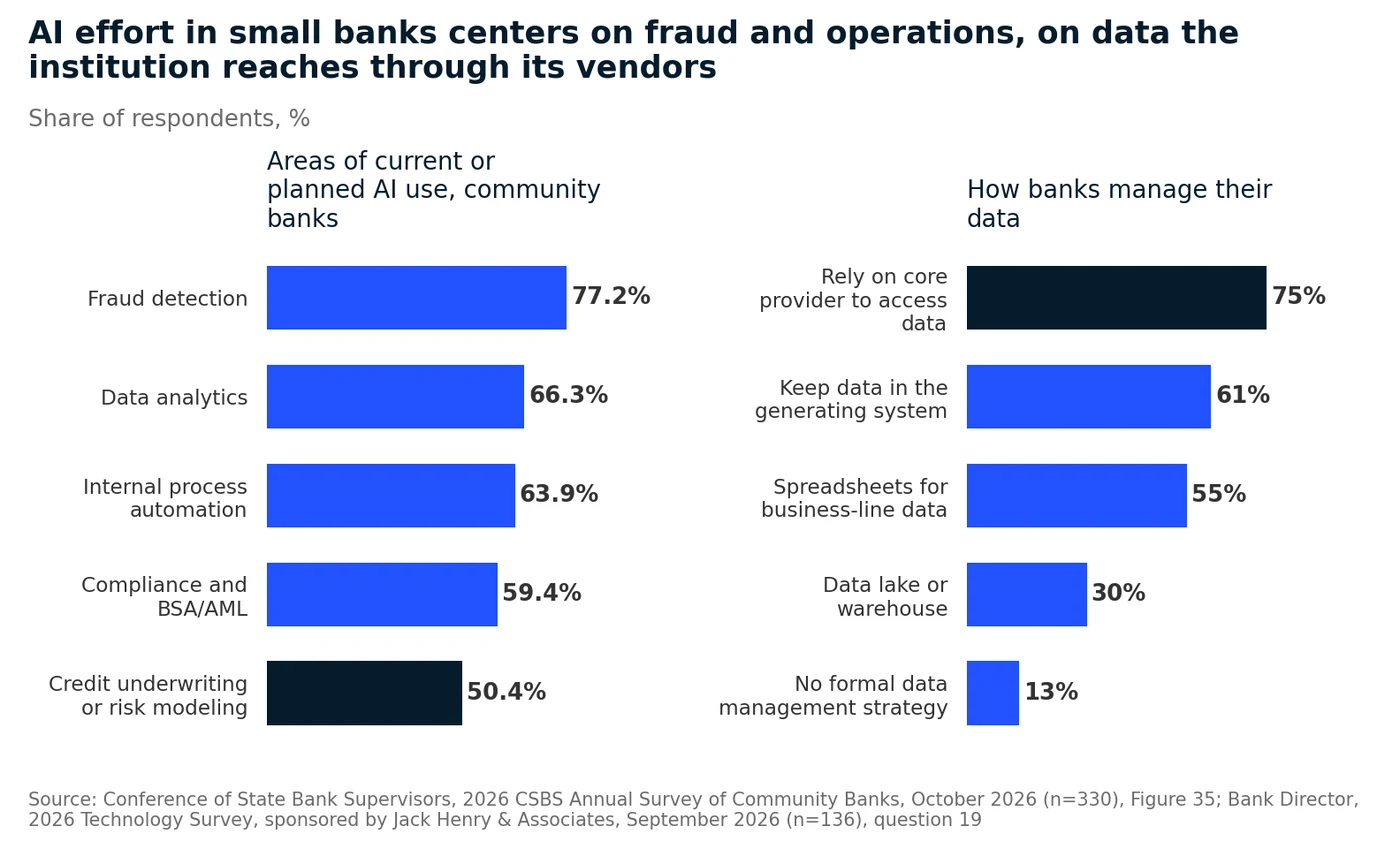
Adoption has moved fast, and little of it touches credit judgment. Bank Director's technology survey of 136 bank leaders found 72 percent had implemented generative AI and 30 percent agentic AI; among users, 49 percent apply generative AI in lending and 17 percent apply agentic AI there. Cornerstone Advisors put generative AI deployment at 49 percent of banks and 59 percent of credit unions, and Jack Henry's benchmark of 193 client executives found AI the top planned technology investment, at 48 percent.16, 17, 18 In the CSBS survey the leading use cases are fraud detection, 77.2 percent, data analytics, 66.3 percent, internal process automation, 63.9 percent, and compliance and BSA/AML monitoring, 59.4 percent, with credit underwriting or risk modeling fifth. Only 11.1 percent of community banks offered automated loan underwriting, and 73.1 percent said they do not offer it and do not plan to.4
The reason is not reluctance. The tools on offer are built around the document, and the institution's knowledge is not in the document. Bank Director's survey describes the plumbing: 83 percent of banks using agentic AI get it embedded in existing third-party applications, 75 percent rely on their core provider to access their own data, 55 percent manage business-line data in spreadsheets and 13 percent have no formal data management strategy (Exhibit 4).16 Abrigo's January survey found only 26 percent of institutions consider themselves very effective at using data for decision-making.19 A vendor's lending agent can extract the borrower's financials, spread them, check them against the policy manual and draft the memo. It cannot know that the manual's global debt service coverage threshold has been applied differently to seasonal agricultural borrowers since a board discussion years ago, or that the guarantor on this file is the family the bank carried through the last downturn and that paid every dollar. Even the industry's own AI guidance points at the vendor: the guide ICBA's AI Task Force published in June is a security readiness guide that covers oversight of vendors and service providers.20
Exhibit 4
The frontier benchmarks say the same thing at larger scale. On the Finance Agent Benchmark v2, updated October 7 with 927 expert-reviewed questions, Gemini 4 Argon leads overall at 65.40 percent and scores 84.8 percent on earnings analysis and 79.7 percent on market analysis. The best scores on tasks that depend on a house's own conventions are far lower: adjustments 60.5 percent, comparables 52.0 percent, precedents 49.8 percent and financial modeling 34.5 percent, and no model passes every part of a question more than 51 percent of the time.21 Precedent is what a community lender's judgment mostly consists of. A Montana banker put it to CSBS this way: "There can be substantial differences between two markets that are only 20 miles away from each other. I don't think AI will be able to replace the knowledge of a banker who has lived in the markets we serve."4 The question for his board is what the bank will know about those two markets on the day he retires.
What a small institution can actually capture
"Local knowledge" sounds unstructured. In practice it decomposes into five objects that a small bank can write down and govern, and that a system can then use. The definition: what this house means by global cash flow, a related party or a seasonal borrower, and where that meaning departs from the policy manual's words. The exception rule: which departures from policy the senior lender would approve, which she would not, and what evidence she would want in each case. The precedent: a fact pattern, a decision and the reason, recorded so a new case can be matched against it. The relationship fact: what is true and material about borrowers, guarantors and local industries and is in no file. And the decision right: who may apply each of these, who may change it, and which cases must still go to a person.
None of this requires a data lake. It requires senior people to spend their final years confirming what the institution's own records already reveal about how they decide. Committee minutes, exception logs, waiver approvals and the notes on spreadsheets are a record of the house's judgment; what is missing is extraction, confirmation and ownership. The evidence on tacit expertise suggests extraction has to start from cases rather than interviews, because experienced people asked to describe how they decide tend to summarize the policy, not the convention that drives the decision.13 The institutions doing this well treat the result as they treat a loan policy: a governed document with an owner, a review cycle and a change log, which a successor inherits and a system can read.
That asset has a value in a merger that the loan book alone does not carry. An acquirer who can see the target's exception conventions and precedent, and keep applying them after the senior lender leaves, is buying a franchise rather than a portfolio. Bank Director's finding that 60 percent of banks that saw consolidation in their markets picked up commercial bankers from it is the mirror image: the knowledge is moving, and it moves to whoever can use it.3
What the people shaping the next four years expect
The forecasts worth weighting come from people with a supervisory mandate, a balance sheet or a survey of the institutions themselves.
- The merger window will stay open, and the rules for passing through it are being rewritten. FDIC Chairman Travis Hill told the House Financial Services Committee in June that the agency is "reevaluating its bank merger review process, with a view towards making the bank merger review process more predictable, timely and transparent," with a proposal expected "in the coming months."22 Bowman said in October that the Federal Reserve's competitive analysis "has a disproportionate effect on rural banks in small and underserved markets," that the Board would consider updating fixed-dollar asset thresholds later this year with a mechanism to update them every five years, and that the agencies "can and should do more to promote new bank formation."8
- Bankers expect AI to change the work without shrinking the workforce. In the CSBS survey, 48.5 percent of community bankers expect AI to increase productivity slightly over the next three to five years and 45.1 percent expect a significant increase; 43.0 percent expect no change in employment, 25.2 percent expect roles to shift, 19.4 percent expect a decline through attrition, and none expect layoffs.4 Attrition is the operative word. The headcount that falls will be senior headcount.
- Bought capability will not stick. Gartner predicted on September 29 that by 2028, 70 percent of enterprises will abandon agentic AI built by vendor forward-deployed engineering because they "fail to build internal capability."23 For institutions where 83 percent of agentic AI arrives embedded in third-party applications, and where the agencies have said a few core providers limit their negotiating power, that is a prediction about who will own the knowledge the tools run on.15, 16
- The investment will outrun the evidence. BIS General Manager Pablo Hernández de Cos said in September that AI-related investment is expected to rise from around $500 billion to between $3 trillion and $4 trillion by 2030, while the median estimate of its effect is around half a percentage point a year of total factor productivity growth, and warned that "should the returns to AI disappoint, a pullback in investment could turn today's capital expenditure boom into a bust."24 Institutions with a median technology budget of $1.72 million, 11 percent of noninterest expense, cannot afford to be on the wrong side of that.16
Our own expectation, grounded in those views, is that the period to 2030 will sort community banks and credit unions into two groups that look alike on a call report and nothing alike in a data room. In the first, the senior lender's definitions, exception rules and precedent exist as governed records that a successor inherits and a system applies, and the succession plan names the people whose knowledge is critical and what has been done about it. In the second, succession is a name in an envelope and the knowledge leaves with the person. By 2028 we expect the first group to command better terms as sellers and make fewer credit mistakes as buyers, and examiners, with or without a rule, to ask how an institution's credit conventions survived its last retirements. By 2030 we expect "what does the institution know that its people know" to be a standard diligence question in community bank and credit union transactions.
Capturing judgment before it leaves: three moves
The institutions closing this gap are not buying a platform. They are doing three things, in roughly this order, with the people they already have.
1. Make the succession plan a knowledge inventory
Start from the NCUA rule's language, whether or not it applies to you. List the positions, then list for each the decisions that person makes that nobody else could make the same way, and the definitions, exceptions and precedents those decisions rest on. The output is not a list of names; it is a map of where the institution's judgment sits and how much of it is written down.
- Concrete marker: The board's succession plan names, for each critical person, the decisions they own and the documented share of the knowledge behind them, and that share rises at every review.
- Concrete marker: "Other personnel the board deems critical" includes the senior lender, the collections lead and the head of each specialty program, not only the CEO and CFO.
2. Extract conventions from cases, then have the owner confirm them
Take recent credit committee minutes, exception approvals, waivers and workout decisions, and use current models to draw out the conventions they reveal: the thresholds actually applied, the evidence actually required, the exceptions actually granted and refused. Then put the result in front of the people who made the decisions and have them correct it.
- Concrete marker: Every recent policy exception has a recorded fact pattern, decision and reason that can be matched against a new application.
- Concrete marker: The chief credit officer has signed off on a written set of house definitions and exception rules, showing where they differ from the policy manual.
3. Own the layer, whoever owns the tool
Definitions, precedent and decision rights should live in a record the institution controls and can hand to any vendor's system, not inside one vendor's application. The agencies' September statement on core providers is the supervisory reason; Gartner's prediction about abandoned vendor-built agents is the commercial one. Govern the record as the loan policy is governed, and require any AI tool used in lending to show which house definition and which precedent it applied.
- Concrete marker: The institution's definitions and precedent can be exported from, and loaded into, a different vendor's system without being rebuilt.
- Concrete marker: Every AI-assisted credit recommendation records the definition, evidence standard and precedent it applied, and which cases went to a person.
The leadership test
None of this is finished anywhere. Directors and executives of a community bank or credit union can test their own position with six questions:
- If our senior lender retired on Friday, which decisions would we make differently on Monday, and would we know it?
- Does our succession plan name the people whose knowledge is critical, or only the people whose titles are?
- Could a new credit officer, or a system, state the exceptions we have granted recently and why?
- Which of our house definitions differ from the words in the policy manual, and is that written anywhere?
- If we sold the institution next year, what could a buyer see of our credit judgment beyond the loan book?
- If we changed core providers or lending platforms, which of our conventions would we have to teach the new system from scratch?
Institutions that can answer these questions have begun to hold their judgment as an asset rather than as a person. Those that cannot will, on the 2026 numbers, face a retirement, a merger or both with the knowledge that priced their loan book already gone.
Community banks and credit unions have always competed on knowing their customers better than anyone with a bigger balance sheet could. That advantage was never in the file. It was in the people, and the people are leaving. The institutions still competing on it in 2030 will be the ones that wrote it down, gave it an owner and made it something a successor and a system could use. The person who knows is still in the building. The work is to capture what they know while that is true.